
What Does an NDIS Support Coordinator Actually Do?
If you have Support Coordination in your NDIS plan, you might have been told that your Support Coordinator can help you “understand and implement your plan”.
Which is technically true, but probably doesn’t tell you much about what we actually do!
In reality, Support Coordination can involve a bit of everything.
We help you understand your funding, find providers, organise supports, keep an eye on budgets, follow things up, deal with problems when they come up and try to make sure all the different people involved in your life are actually communicating with each other.
Sometimes it’s straightforward.
Sometimes it really, really isn’t.
It starts with understanding your plan
One of the first things I do with a new participant is actually look at the plan and work out what we have to work with.
How much funding is there? How is it managed?
Are there funding periods? What supports are already in place?
What's missing? Is the current spending actually sustainable for the length of the plan?
And, most importantly, what does the participant actually want help with?
Because having funding written in an NDIS plan and having supports that work well in real life are two very different things.
We find providers — but that's only part of it
〰️
We find providers — but that's only part of it 〰️
Finding providers is definitely part of Support Coordination, but it shouldn't just be a case of sending you the first provider that comes up on Google.
If you need an OT, Speech Pathologist, Behaviour Support Practitioner, support worker or another service, we'll look at what you actually need and try to find suitable options.
That might mean considering location, waitlists, experience, availability, how they work, whether they understand your disability or support needs and, honestly, whether they seem like they will actually be a good fit for you.
You should still have a choice. We're there to help you understand the options, not choose your entire support team for you.
Then we actually have to get everything organised
This is the part people don't necessarily see. There's usually quite a lot happening behind the scenes.
Referrals need to be sent. Funding needs to be checked. Service agreements need to be reviewed. Providers need information. Appointments need to be organised. Reports need to be followed up.
And when you have several different providers involved, somebody usually needs to make sure everyone knows what's happening.
A participant might have an OT, Speech Pathologist, Behaviour Support Practitioner, support workers, a SIL provider, Plan Manager, guardian and family members involved.
That's a lot of people. Part of our job is helping keep everyone on the same page.
We keep an eye on the money too
This is a big one.
Just because there is money sitting in an NDIS plan doesn't necessarily mean the current level of spending can continue for the whole plan.
If you're spending $2,000 a week but your budget only works out to $1,300 a week across the life of the plan, we need to know about that.
Preferably now. Not when there is $14 left.
We look at what has been spent, what's left, what regular services are costing and what other expenses might be coming up.
Sometimes that means having an awkward conversation and saying, “At this rate, the funding isn't going to last.” I'd much rather have that conversation early enough that we can actually do something about it though.
And then there are the things nobody planned for
〰️
And then there are the things nobody planned for 〰️
This is probably where a lot of the actual work happens.
A provider suddenly stops. A therapist leaves.
Someone ends up in hospital. A living arrangement breaks down.
Funding starts running low. A report doesn't get completed.
A participant's circumstances change completely.
Or five different people are telling you five different things and nobody seems to know what is actually happening.
This is where your Support Coordinator should be helping you work out:
Okay. What's happening, what needs to happen next and who do we need to involve?
We might not be able to magically fix every problem — unfortunately we don't have that kind of power — but we can help work through the options and keep things moving.
We don't only work with NDIS providers
Another misconception is that Support Coordinators only deal with NDIS services.
We don't.
Depending on the person we're supporting, we might be talking to hospitals, housing services, schools, guardians, financial managers, Centrelink, community organisations, justice services or other mainstream services. Not everything can or should be funded by the NDIS.
Part of our job is working out where the NDIS fits and helping connect the different systems around the person.
For participants with more complicated circumstances, this can become a pretty significant part of Support Coordination.
We should also be looking ahead
I don't like waiting until a plan reassessment is around the corner before suddenly asking everyone for reports.
If we know evidence is probably going to be needed, we should be talking about it earlier.
If funding is starting to look tight, we should be looking at it earlier.
If a support arrangement clearly isn't working, we shouldn't wait six months and hope it somehow fixes itself.
Things will always come up unexpectedly, but good Support Coordination should involve at least some forward planning.
What we don't do
We're not here to run your life. We're also not here to make every decision for you.
We can explain your options, give recommendations, point out concerns, coordinate services and tell you when we think something isn't working.
But you're still the person we're working for.
A good Support Coordinator should help you have more understanding and control over your supports, not make you feel like somebody else has taken over your NDIS plan.
So what should you expect from your Support Coordinator?
For me, it comes down to a few pretty basic things.
You should know what's happening. You should be able to ask questions.
You should understand your options. Things should actually be followed up.
And if there's a problem, you should be told about it rather than finding out when it's already become a disaster.
That's a big part of why we called ourselves Straightforward Support Coordination.
The NDIS can be confusing enough without us making it more complicated.
We're here to help you understand what's happening, work out what needs to happen next and get on with it.
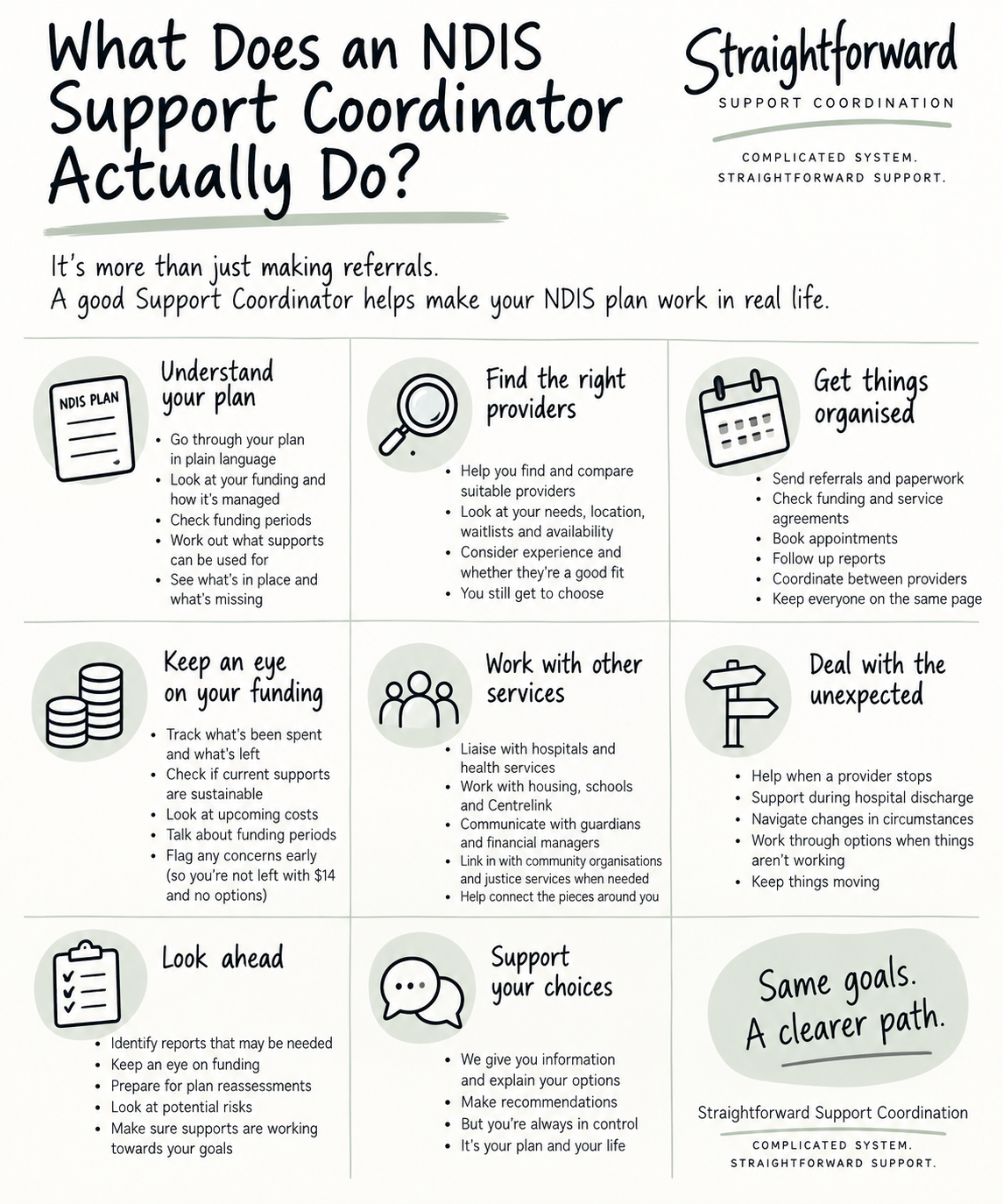
Simple Straightforward Support Coordination infographic explaining what an NDIS Support Coordinator does, including understanding NDIS plans, finding providers, monitoring funding, coordinating services, planning ahead and helping participants make informed choices.
Straightforward Support Coordination
Making a complicated system a little more straightforward.
This article provides general information about NDIS Support Coordination and isn't individual advice about your NDIS plan. NDIS policies and processes can change, so always check current NDIA information or ask about your individual circumstances.
Ashlee Starr is a Support Coordinator and co-founder of Straightforward Support Coordination. She works with NDIS participants and their families to make sense of plans, funding and services, particularly when there are a lot of moving parts involved.
Ashlee started Straightforward with a pretty simple idea: Support Coordination should make things clearer, not more complicated. She takes a practical approach to her work, explains things in normal language and isn't afraid to ask questions, follow things up or say when something doesn't look right.
Through the Straightforward blog, Ashlee shares practical information based on the questions, problems and confusing NDIS situations that come up in everyday Support Coordination.
